From Complexity to Confidence: Building Developer Trust in Enterprise AI Agents
At a Glance
Role—I served as the primary user researcher shaping design direction and informing product strategy for AI Agents in automation
Methodology—I designed and executed a phased research program of quick-turn usability tests, end-to-end prototype evaluations, and journey mapping workshops with expert automation developers
Impact—My research analysis and insights:
identified conceptual gaps, usability barriers, and governance concerns that shaped design, onboarding, and documentation
reduced adoption risk by showing where developers would struggle and by defining the transparency features needed for enterprise trust
influenced adoption planning by surfacing the user needs and trust signals critical to positioning AI Agents as enterprise-ready
Research Artifacts—Research plans and stakeholder insights shareouts
Overview
In early 2023, Automation Anywhere's move to agentic process automation marked a defining moment. For more than a decade, the company's leading robotic process automation (RPA) platform Automation 360 (A360) helped enterprises streamline repetitive, rules-based work. But traditional bots follow deterministic workflows, leaving more complex, dynamic processes out of reach. To close this gap, agentic automation emerged as the next wave of enterprise transformation—promising business impact on a scale far beyond what RPA could deliver.
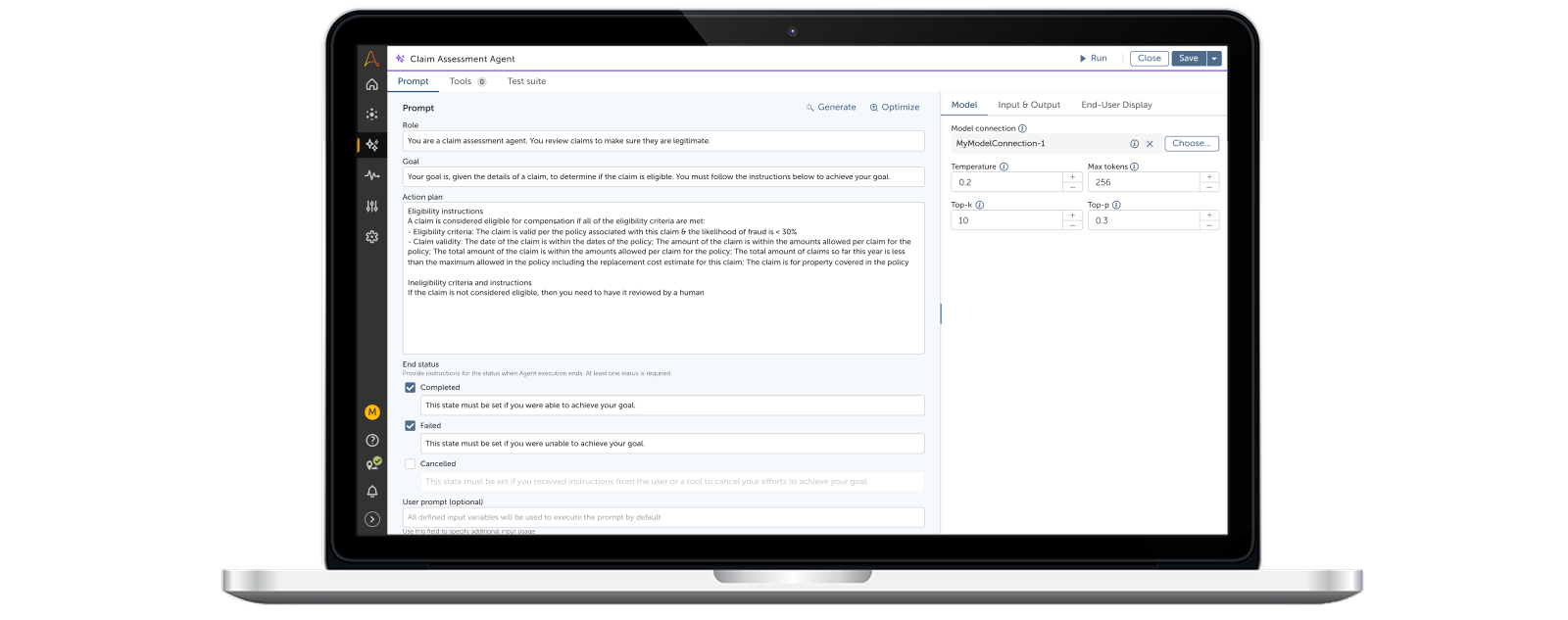
In Automation 360, an AI Agent is an intelligent automation that can interpret a business process goal, plan the steps, and carry them out using connected tools and automations.
AI Agents extend the A360 platform with large language model reasoning, enabling customers to automate work once thought impossible—complex decisions, adaptive processes, and mission-critical operations—with full transparency into how outcomes are achieved. This propels automation beyond back-office tasks into domains requiring judgment, flexibility, and continuous learning.
For enterprise customers, the promise of AI Agents is compelling—but also fraught with uncertainty and risk. Enterprise Centers of Excellence (CoEs) are responsible for scaling automation securely and performantly across global organizations. Demanding transparency, predictability, and security as much as innovation, for these customers adoption depends on whether AI Agents can be understood, trusted, and controlled in production environments.
Problem Space
Business Context
AI Agents represented a radically different model for automation development, tightly coupling large language models, planning systems, and governance controls into a new end-to-end framework. For customers, this shift carried both opportunity and risk: adoption would depend on whether such a system could be designed in a way that was comprehensible, trustworthy, and usable.
Design Challenges
This agentic automation framework introduced constructs and workflows (prompt engineering, tool configuration, and testing) that demanded new mental models. The architecture layered in planning horizons, reasoning traces, and governance for security and risk management. emerging features that were inseparable from the agent experience.
Without careful design, these advances risked overwhelming the very experts meant to champion them, making usability and governance equally central to adoption. Thus, the stage was set for user research!
Research Goals
Starting in fall 2024, while absorbing emergent domain knowledge I shaped the research approach in partnership with my cross-functional stakeholders. I defined research hypotheses and questions that focused not only on usability, but also on the conditions for adoption and trust in a radically new automation model.
These questions reflected the uncertainties of an entirely new automation paradigm and anticipated adoption metrics such as task completion, onboarding conversion, and sustained usage.
Workflow usability
🔎 Can developers complete end-to-end tasks such as prompt creation, model connection, tool configuration, and testing without unnecessary friction?
👉 If workflows are too complex, even experts may abandon agent development
Conceptual clarity
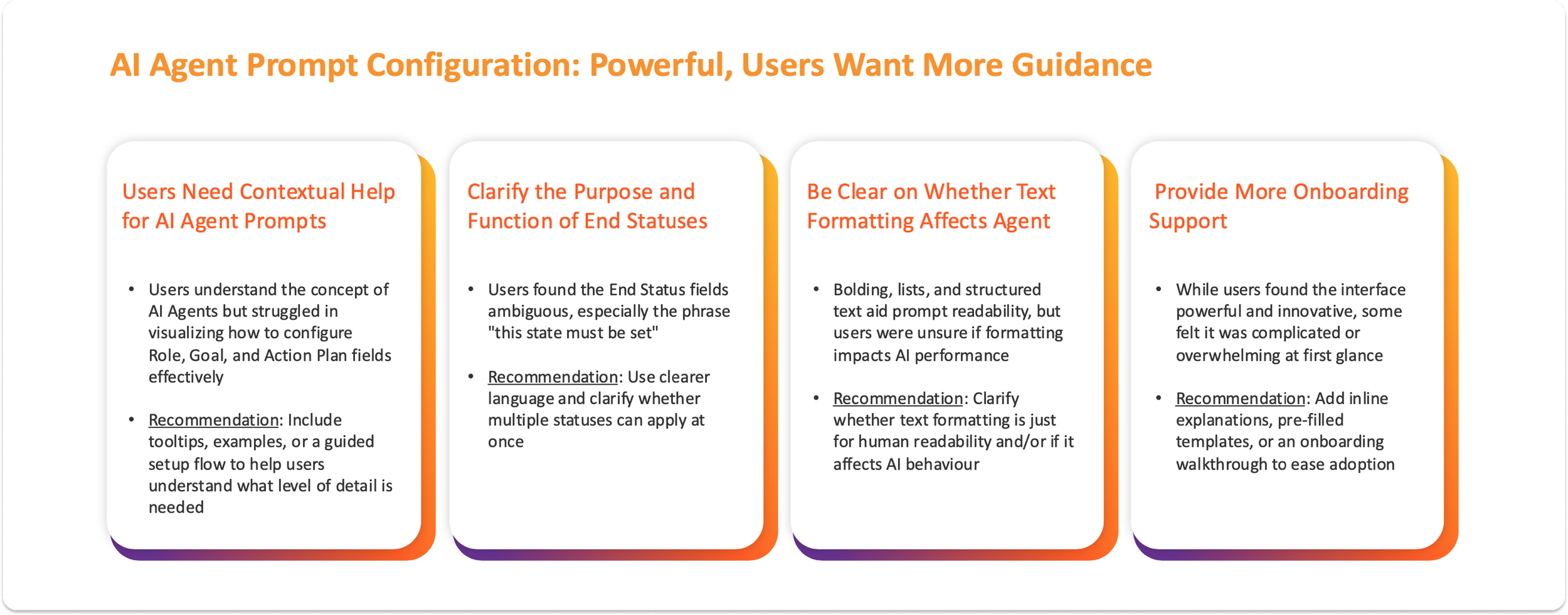
🔎 How do developers interpret new agentic constructs such as Roles, Goals, Action Plans, and End States, and where do their mental models break down?
👉 Without shared understanding, adoption risks stalling before pilots begin
Trust signals
🔎 What forms of transparency (reasoning traces, execution logs, error states) are necessary for developers to feel confident deploying agents in production?
👉 Without transparency, AI Agents will be seen as opaque and unsafe
Adoption readiness
🔎 Does the experience support adoption outcomes such as higher task completion, onboarding conversions, and active usage?
👉 Sustained adoption depends on reducing friction to first success and building habits of continued use
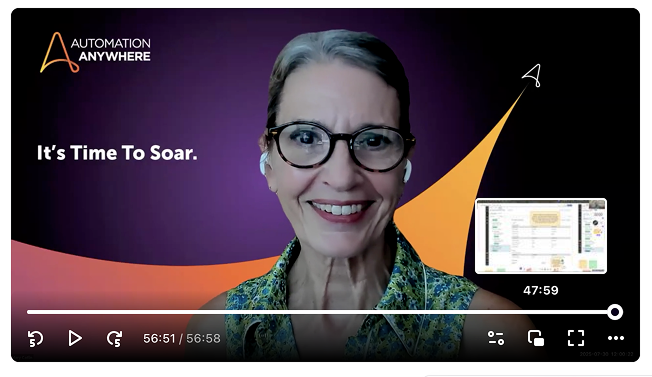
Leading a developer journey mapping session
Use case fit
🔎 How do customers map AI Agents to enterprise processes, and which mission-critical scenarios are seen as viable candidates for agentic automation?
👉 Without clear use cases, AI Agents risk being perceived as an experimental feature rather than a strategic capability
Methodology
From March through August 2025, I conducted a phased program of research to evaluate how enterprise developers experience the AI Agent development flow. To build trust with my team, I committed to delivering insights within one week for each study. As the product was still in a functional requirements stage, all studies were conducted using design prototypes that I created in Figma working from the UX designers' files. This allowed me to test core workflows and concepts before engineering investment, giving stakeholders early evidence to guide design decisions and roadmap priorities.
-
I ran a sequence of unmoderated studies across Helio and Maze, each focused on a segment of the AI Agent configuration: system prompt, model connection, variables, tool configuration including human-in-the-loop (HITL), and testing.
By breaking the end-to-end flow into discrete steps, I was able to generate weekly insights on comprehension of new constructs and workflow usability.
-
I designed and conducted a UserTesting study in which five participants completed the full AI Agent configuration and test flow using two Figma prototypes I created.
This revealed how the workflow held together as a complete experience.
-
I facilitated participatory sessions with advanced automation developers from the Pathfinder Community, run in two parts, where participants walked through prototypes and co-created journey maps of the AI Agent experience.
These sessions uncovered conceptual friction points and governance-related concerns not always visible in the quick-turn studies.
Insights and Strategic Impacts
Through the research, I surfaced barriers that threatened adoption—and worked with stakeholders to translate them into actionable changes. These insights fed directly into the design, documentation and onboarding materials, adoption strategy and metrics framework.

Conceptual clarity
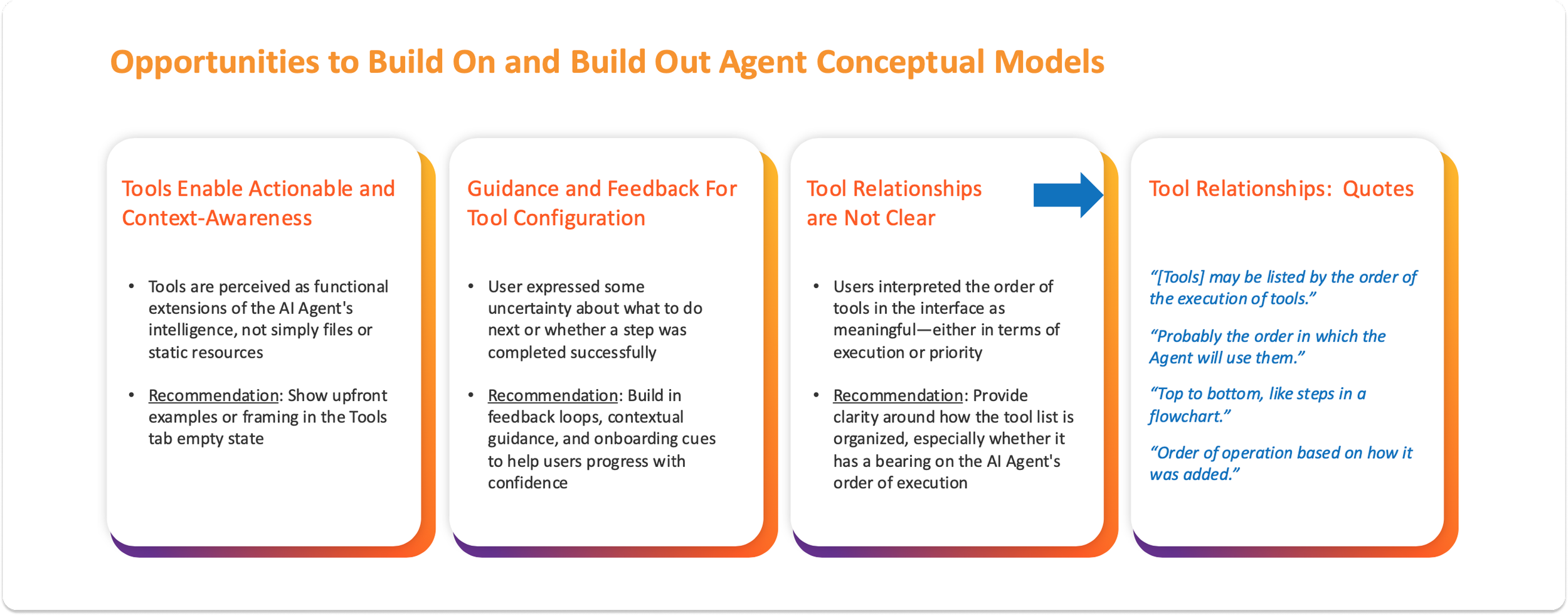
The core constructs were clear; the challenge was assembling them into a working agent. Developers needed stronger scaffolding across model selection, variable schemas, tool orchestration, and testing to feel confident about outcomes. I highlighted these gaps, leading to clearer terminology and onboarding scaffolding.
Adoption metric: Improved Pendo guide conversion rate for “Create AI Agent” onboarding


Workflow usability
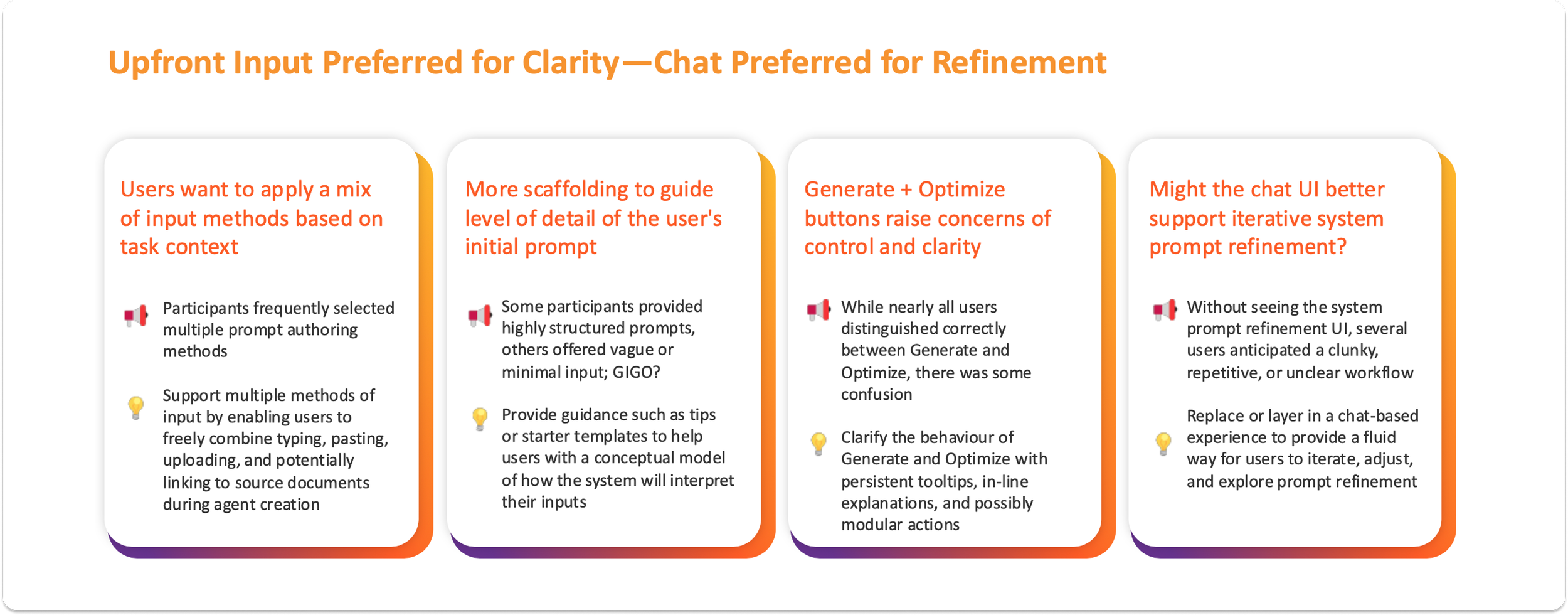
Step-level studies showed friction in prompt creation, variable defintion, and tool configuration. My findings informed design changes that streamlined flows, added scaffolding, and clarified sequencing cues.
Adoption metric: Higher task completion rates in create–test–deploy flows

Trust signals
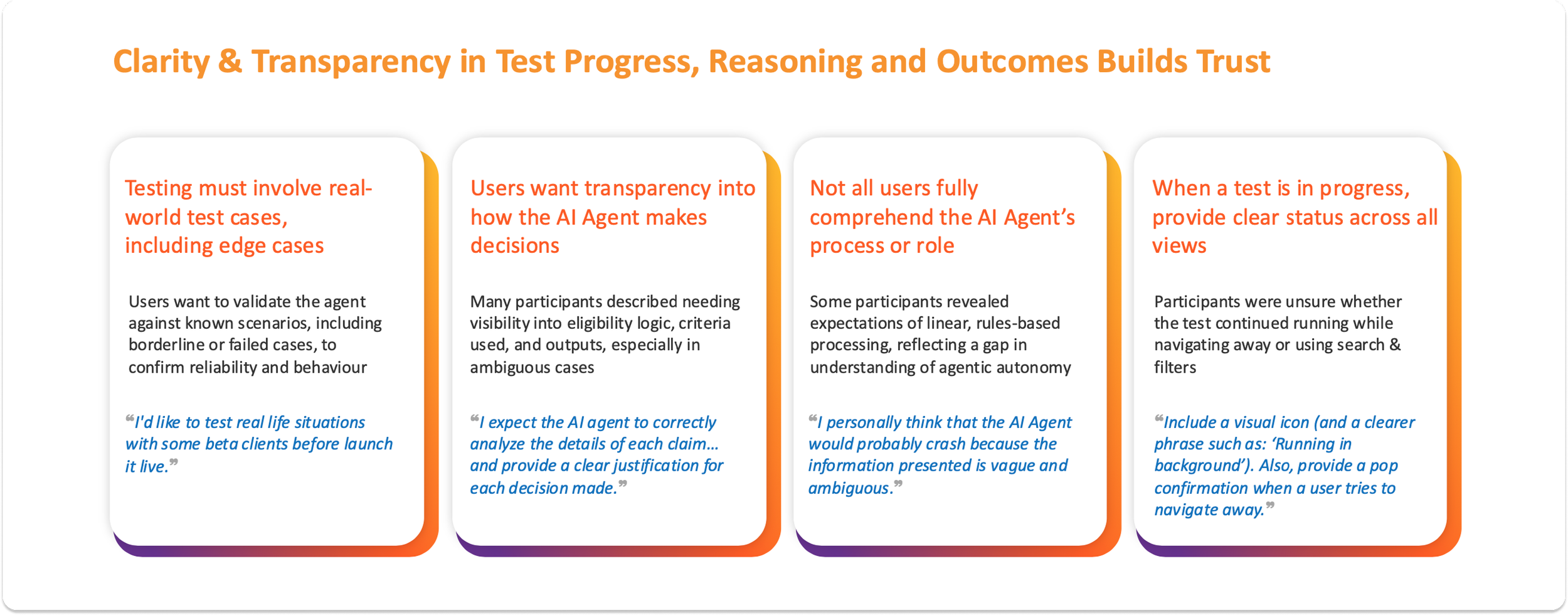
Participants wanted clearer reasoning traces, logs, and error handling. My findings highlighted that transparency was essential for developers to trust agents in production.
Adoption metric: Increase in repeat usage and monthly active users (MAUs)

Adoption readiness
Enthusiasm was tempered by friction in first-time setup. I surfaced the challenge of measuring adoption in a domain where building requires multiple sessions and shared configuration, underscoring the need to track sustained usage.
Adoption metric: Tracking of multi-session completion rates, rather than single-session drop-offs

Safe entry points
In many Pathfinder user group sessions I had observed, customers repeatedly struggled to identify “safe” starting points for agentic automation. From the MVP journey mapping, I noted how participants focused on transparency and governance concerns when working through the prototype.
Adoption metric: Number of low-risk pilot agents deployed in early adoption
Conclusion
As the sole researcher in this technically demanding and fast-moving domain, I designed and executed a research program that balanced breadth with depth: quick-turn, targeted studies for usability detail, and participatory workshops for conceptual insight. I generated findings that kept pace with product development, and aligned stakeholders with confidence to make decisions.
This research reduced adoption risk by exposing where developers would struggle, and strengthened trust in AI Agents by showing the transparency features required for enterprise confidence. It helped leadership see adoption not as a single moment of conversion, but as a multi-session journey shaped by safe entry points, governance, and repeatable success.
While hard adoption metrics will follow as the product moves from beta to production, the foundation is already in place: a structured adoption plan, aligned measures of success, and a clearer understanding of what it will take for enterprises to trust and scale AI Agents.
Quisque iaculis facilisis lacinia. Mauris euismod pellentesque tellus sit amet mollis.